The first version of the match looked wrong to anyone who watches football. The ball pinged between players like it was on elastic, nobody ran with it, and both teams moved like table football. This is how it changed.
The problem with a grid
The original engine split the pitch into a grid and decided one action every few seconds: a pass to another square, a tackle, a shot. It produced believable scores and statistics, which is what a management game needs most. But watched on the pitch, a pass every tick looks like ping-pong however smoothly you draw it. There's no way to show a player carrying the ball for two seconds, a full-back overlapping, or a back four stepping up together.
Continuous movement
The match now runs as continuous movement. Every player has a position, a speed and a job, and decisions happen when they would on a real pitch: when the ball arrives, when space opens up, when a defender closes in. Players carry the ball when there's room ahead, take on a defender when they're good enough to, and pass when a teammate is in a better place.
To know what "looks like football" means, we checked the engine against real match tracking data. Some of what that shows:
- Most carries are short (a couple of metres), but the longest tenth go nine metres or more. Those long runs are what make a match feel alive.
- Teams in possession spread to about 48 metres wide and squeeze to about 36 out of it.
- A whole team slides about half a metre for every metre the ball moves. Individual movement around that (runs, pressing, marking) is just as big as the team's shift, which is why a rigid shape looks robotic.
- Sideways passes that cross most of the pitch are rare. The first engine played far too many.
A team that moves as one
Each side now knows what phase it's in: building up, progressing, in the final third, just won the ball, just lost it. Each phase gives the team a target shape (how long, how wide, how high the back line sits) and every player's position comes from that shape plus his role. The back four hold one line, step up when the ball goes backwards, and drop when a forward-facing midfielder has time on the ball.
Tactics you can see
The old engine damped most tactical settings, so a high line and a deep one looked almost the same. Now each instruction maps to something you can measure on the pitch. A high line really does sit ten or fifteen metres further up, and "wide" really does stretch the team. You can watch the change happen when you make it mid-match.
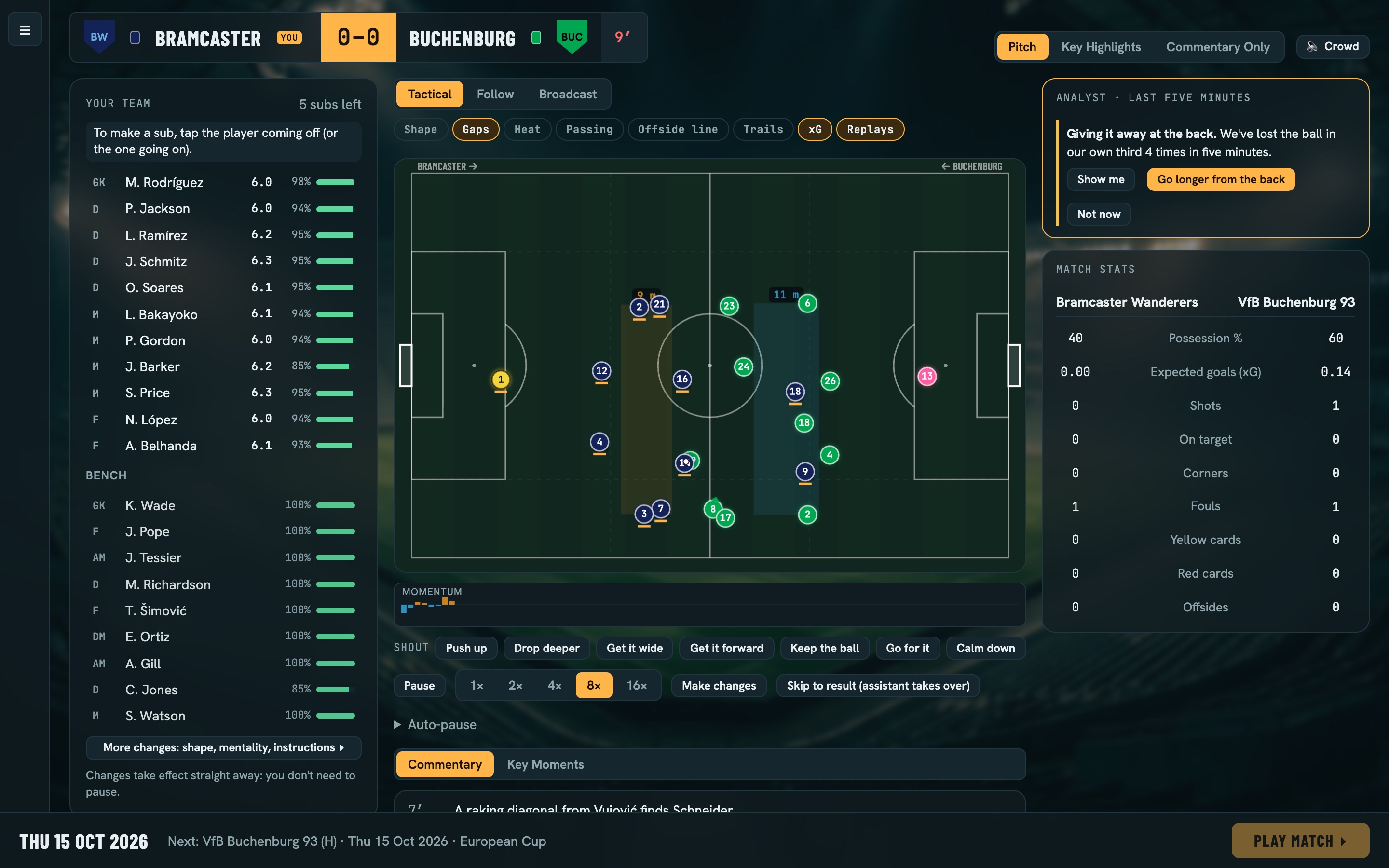
An analyst who can see it too
Because the engine knows where everyone is, it can measure the things a coach looks for: the gap between your defence and midfield, who's receiving the ball between your lines, whether your press is being played through. The analyst watches the last five minutes, tells you what's going wrong, shows it on the pitch, and offers a fix you can apply with one click.
All of this had to happen without breaking the numbers. Goals, shots, pass completion and home advantage still match the targets the old engine was tuned to, so your results mean the same as before. They just look like football now.